
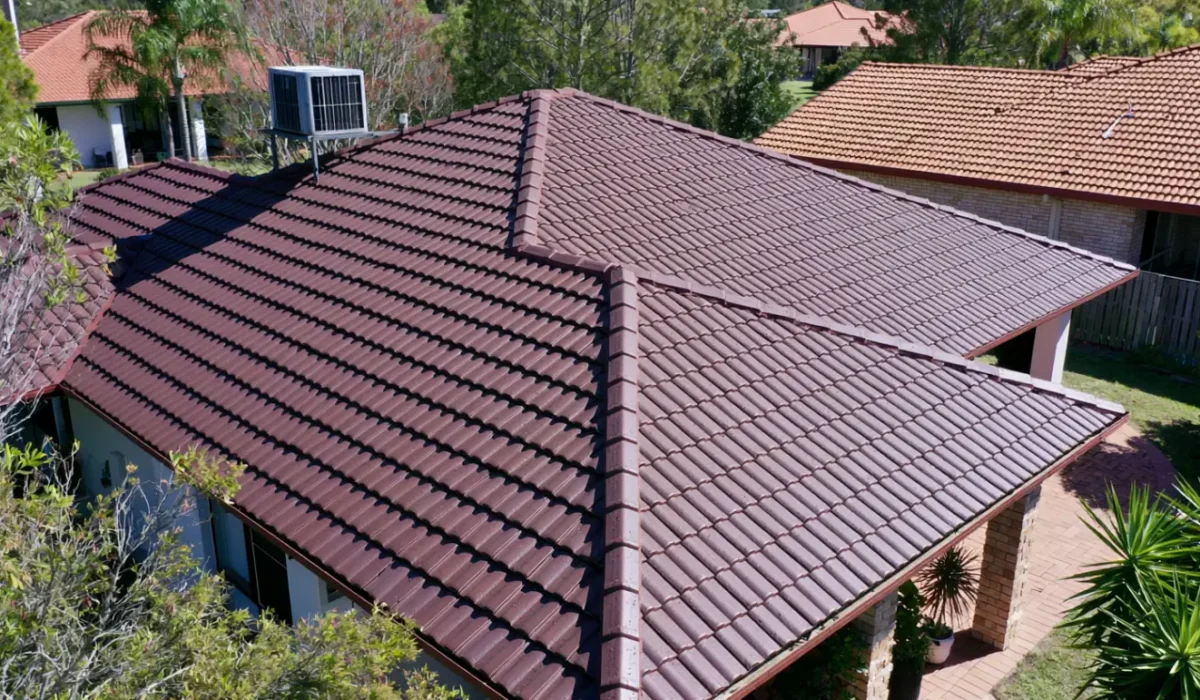
Tile Roofing San Diego, located in San Diego, CA, helps homeowners, HOAs, and property managers evaluate tile choices against California energy rules, permit requirements, and neighborhood standards. For a San Diego roof replacement, “cool roof” does not simply mean choosing a light color. Compliance depends on the permit date, building type, roof slope, project scope, climate zone, exact product rating, and any applicable exception.
What Title 24 Means for a San Diego Tile Roof
Title 24 is the California Building Standards Code. Its energy-efficiency provisions are contained in Part 6 and are commonly called the California Energy Code. Permit applications submitted on or after January 1, 2026, generally fall under the 2025 California Energy Code, while earlier permit applications may remain subject to the prior code cycle. Homeowners should verify the applicable code edition before ordering tile, not after materials arrive.
A cool roof absorbs less solar heat than a comparable conventional roof. It does this through two measured properties: solar reflectance, which describes how much sunlight the surface reflects, and thermal emittance, which describes how efficiently the surface releases absorbed heat. The Solar Reflectance Index, or SRI, combines both properties into one value and can provide an alternative compliance method.
Title 24 does not require every roof to be white. Reflective pigments and finishes allow clay and concrete tiles to retain Spanish, Mediterranean, mission, flat, or shake-like appearances while outperforming comparable conventional dark products.
Contact Us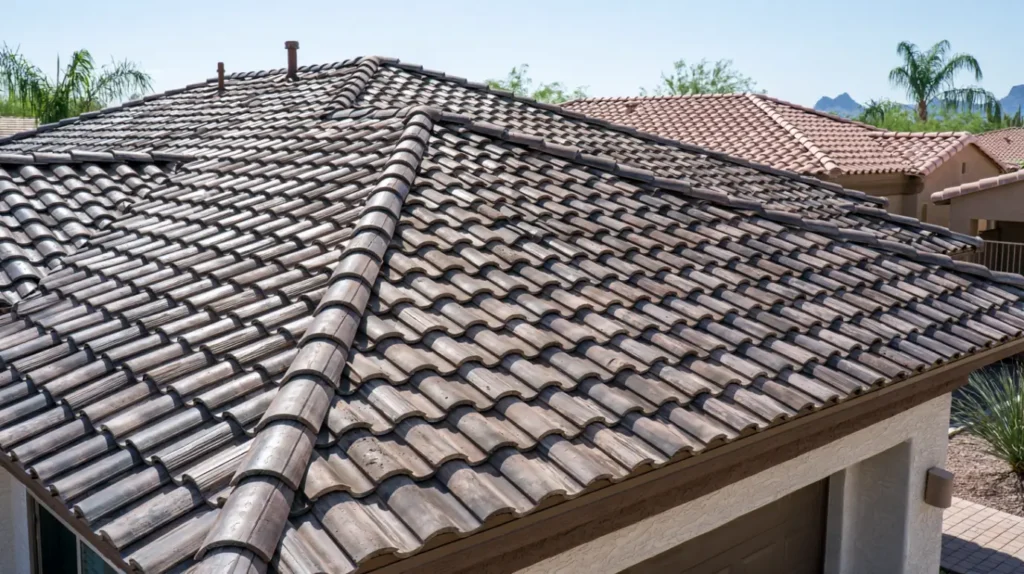
San Diego Climate Zones Change the Requirement
The City of San Diego includes areas in California Climate Zones 7 and 10. Climate Zone 7 covers much of the mild coastal area, while Climate Zone 10 includes hotter inland locations. Because a ZIP code can cross a climate-zone boundary, we recommend confirming the project address through the California Energy Commission’s climate-zone tool or the local building department rather than relying on a general county map.
This distinction is especially important for steep-slope tile roofs. Under the 2025 single-family prescriptive rules, steep-slope cool-roof requirements for new construction apply in Climate Zones 10 through 15. For steep-slope roof alterations replacing at least half of the roof area, the prescriptive cool-roof rules apply in Climate Zones 4 and 8 through 15. A qualifying steep-slope reroof in San Diego’s Climate Zone 10 may therefore trigger cool-roof criteria, while a similar project in Climate Zone 7 may not trigger the same statewide prescriptive requirement.
Low-slope replacement roofs are treated more broadly. For single-family roof replacements, the 2025 compliance manual directs low-slope areas in Climate Zones 4 and 6 through 15 to meet the applicable low-slope criteria under the prescriptive approach. That includes both Climate Zone 7 and Climate Zone 10 properties in San Diego. Mixed-slope homes may need separate compliance treatment for their low-slope and steep-slope sections.
Low-Slope Versus Steep-Slope Roofs
Title 24 classifies a roof with a pitch below 2:12 as low-slope. A roof pitched at 2:12 or greater is steep-slope. Most concrete, clay, and Spanish tile roofs are steep-slope because overlapping tile systems need sufficient drainage. However, San Diego homes frequently combine tile-covered pitched sections with low-slope membrane roofs over additions, garages, patios, balconies, or modern architectural wings.
A contractor cannot use a steep-slope tile rating to document a low-slope membrane section, and a compliant low-slope coating does not establish compliance for the tile field. Plans should identify each roof area, slope, replacement square footage, material, and climate zone. This prevents the common error of documenting the visible tile roof while omitting a smaller low-slope section.
Current Cool Roof Performance Values
For a prescriptively compliant steep-slope roof under the current single-family standards, the core benchmark is a minimum three-year aged solar reflectance of 0.20 and a minimum thermal emittance of 0.75, or a minimum SRI of 16. For qualifying low-slope applications, the familiar benchmark is an aged solar reflectance of 0.63 and thermal emittance of 0.75, or an SRI of 75, although low-slope alterations may involve roof-deck insulation combinations and other provisions that must be checked in the applicable compliance table.
The phrase three-year aged is critical. An initial rating measures a new product. The aged rating represents performance after weather exposure and soiling. California uses aged solar reflectance because a roof that begins highly reflective but rapidly loses that performance may not deliver the intended long-term energy benefit.
The Cool California cool roof codes and standards resource explains that the Cool Roof Rating Council maintains the recognized third-party product directory and publishes initial and aged ratings. The California Energy Commission recognizes CRRC ratings for code compliance; a generic manufacturer claim, an unverified laboratory number, or an older ENERGY STAR label is not a substitute for the required CRRC documentation.

How to Verify That a Roof Tile Is Title 24 Compliant
We recommend verifying the exact tile rather than accepting a broad claim that a product line is “Title 24 ready.” Ratings can change by material, profile, finish, color, and manufacturing location. The submittal should identify the manufacturer, product name, profile, color, CRRC product ID, aged solar reflectance, thermal emittance, and SRI where used.
Those values must match the tile actually ordered. A visually similar color can carry a different rating, so post-approval substitutions require review. Homeowners should also confirm that the CRRC listing remains active and that permit documents use the correct code cycle; older literature alone does not prove compliance with a 2025-code project.
Cool Roof Tile Colors, Clay, and Concrete
“Cool color” pigments can reflect more near-infrared solar energy while maintaining terracotta, tan, sand, gray, muted red, and selected brown palettes. Clay is not automatically compliant: glaze, color, firing method, texture, and finish affect its rating. Concrete tile offers broad choices, but dark conventional colors may fall below the required aged reflectance. Compliance comes from the exact CRRC listing, not the material category.
At Tile Roofing San Diego, we recommend comparing compliant products at the start of design, especially in HOA-governed communities. Early coordination gives the owner time to find a tile that satisfies energy requirements, architectural guidelines, product availability, and future replacement needs without delaying the permit.
HOA Approval Does Not Replace Code Compliance
An HOA may regulate material, profile, color, sheen, edge shape, and visible accessories, but those private controls do not replace the building code. A tile can be HOA-approved yet fail the energy standard, or code-compliant yet fall outside the community palette.
We advise submitting both packages together: the exact sample and profile for architectural review, plus CRRC and energy data for permitting. Property managers may keep a pre-screened product list, but each listing should be rechecked because tiles can be reformulated, rerated, or discontinued. Any conflict between the approved palette and compliant products should be resolved before nonreturnable materials are ordered.

When the 50 Percent Reroof Trigger Applies
For existing single-family homes, the California manual states: “Cool roof requirements are triggered when 50 percent or more of the roof area is being replaced.” The building department may evaluate the total scope, permit history, and roof area involved rather than treating artificially divided contracts as unrelated work.
A small broken-tile repair may not trigger the same rules as a reroof. A lift and relay—tile removal, underlayment replacement, and tile reinstallation—requires closer review because it commonly receives reroof treatment. Reusing the original tile does not automatically remove Title 24 considerations.
Mixed projects also require careful measurement. The scope should separate each roof area, slope, material, and square footage so the permit reviewer can determine how the trigger applies.
Important Exceptions for Steep-Slope Reroofs
The prescriptive cool-roof requirement may be waived when a listed exception applies. Under the 2025 single-family guidance, examples include a building with at least R-38 ceiling insulation, a qualifying attic radiant barrier, at least R-2 insulation above or below the roof deck, and—in specified climate zones, including Climate Zone 10—a building with no ducts in the attic.
There are also exceptions for roof areas covered by qualifying building-integrated photovoltaic or solar-thermal systems and for roof constructions weighing at least 25 pounds per square foot. Homeowners should not assume that ordinary clay or concrete tile reaches the 25-pound threshold; the complete assembly weight must be documented.
An exception must be documented through plans, product data, photographs, field verification, insulation records, or energy forms. When the prescriptive path is impractical, an approved performance approach may demonstrate whole-building compliance through energy modeling.
Cool Roof Tiles and Solar Panels
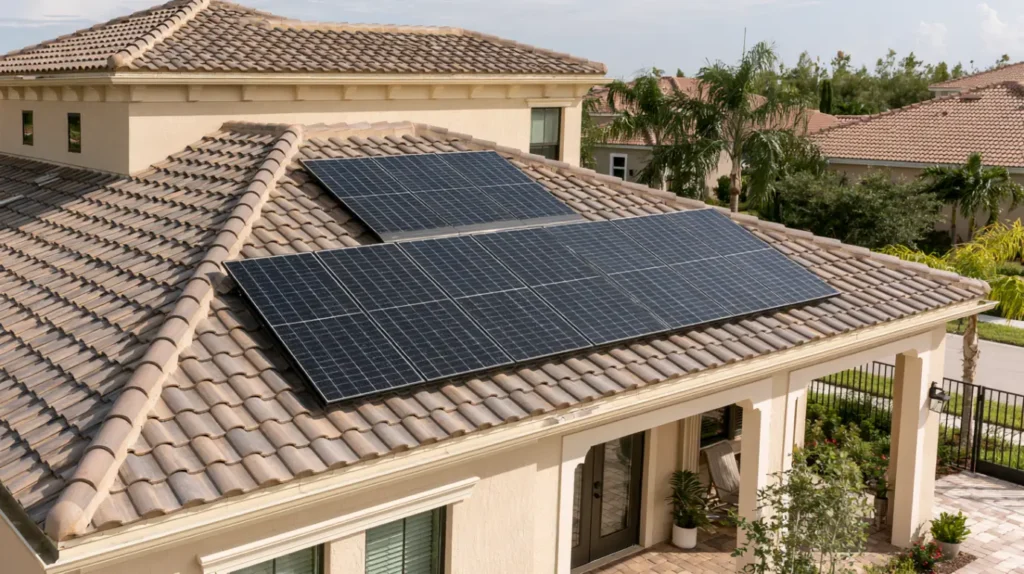
Solar panels and cool roof tiles can work together, but one does not automatically replace the other. The 2025 compliance guidance explains that only the active photovoltaic area receives the relevant exemption in an integrated-product example; visually matching inactive filler pieces still require compliant roofing treatment. Rack-mounted systems, setbacks, access pathways, and future panel removal can create additional questions.
Coordinate roofing and solar scopes before work begins. Confirm panel removal and reinstallation, attachment changes, spare matching tiles, and exposed roof areas. Permit documents should distinguish active solar coverage from ordinary tile and support any claimed exemption.
Energy savings still depend on insulation, attic ducts, ventilation, air leakage, orientation, shading, HVAC efficiency, and occupancy. Tile color alone cannot support a fixed utility-bill promise.
The Roof Tile Is Only One Part of the Assembly
Title 24 ratings describe surface performance; they do not replace sound roofing design. Durability still depends on the deck, underlayment, flashings, valleys, fasteners, battens, penetrations, drainage, ventilation, and solar-mount detailing.
Tile sheds water but is not the primary waterproof barrier. A high-SRI tile over deteriorated underlayment remains a leak risk, while a sound assembly with poor documentation can face inspection delays. The specification should identify the tile rating, underlayment, flashings, ventilation, attachment method, accessories, and deck or insulation upgrades.

Title 24 Cool Roof Tile Checklist
Before authorizing materials, homeowners, HOA boards, and property managers should confirm:
- The permit application date and applicable Energy Code cycle.
- Whether the property is in Climate Zone 7, Climate Zone 10, or another county zone.
- Whether the building is single-family, multifamily, or nonresidential.
- The slope and square footage of every roof section.
- Whether at least 50 percent of the roof area will be replaced.
- The exact CRRC listing for the selected tile profile and color.
- Whether the project uses prescriptive compliance, an exception, or performance modeling.
- Whether HOA approval is required before ordering.
- Whether solar removal, reinstallation, or integrated solar products affect the scope.
- Whether the permit set, purchase order, delivery, and installed product all match.
Conclusion
Title 24 cool roof tile compliance in San Diego is an address-specific and project-specific determination. Coastal Climate Zone 7 and inland Climate Zone 10 can produce different steep-slope requirements, while low-slope replacement sections receive separate treatment. The safest process is to identify the code cycle, verify the climate zone and roof slope, determine whether the 50 percent trigger or an exception applies, select the exact CRRC-rated tile, coordinate HOA approval, and preserve all documentation through final inspection. A compliant tile should also be part of a complete roof assembly designed for drainage, underlayment durability, solar coordination, and long-term service in San Diego’s coastal and inland conditions.
Frequently Asked Questions
Are all clay and concrete roof tiles Title 24 compliant?
No. Compliance depends on the exact product, color, finish, aged solar reflectance, thermal emittance, SRI, roof slope, climate zone, and project type. The specific tile should have a current CRRC listing that supports the permit documents.
Does a steep-slope tile reroof in San Diego always require cool roof tiles?
No. A qualifying reroof in Climate Zone 10 may trigger the prescriptive steep-slope criteria when at least 50 percent of the roof is replaced, while Climate Zone 7 is treated differently under the statewide single-family alteration rules. Exceptions or performance compliance may also change the result.
Can an HOA require a roof tile color that does not meet Title 24?
An HOA can regulate appearance, but it cannot authorize work that violates applicable building and energy codes. The owner should select a tile that satisfies both the HOA’s design standards and the permit requirements before materials are ordered.