
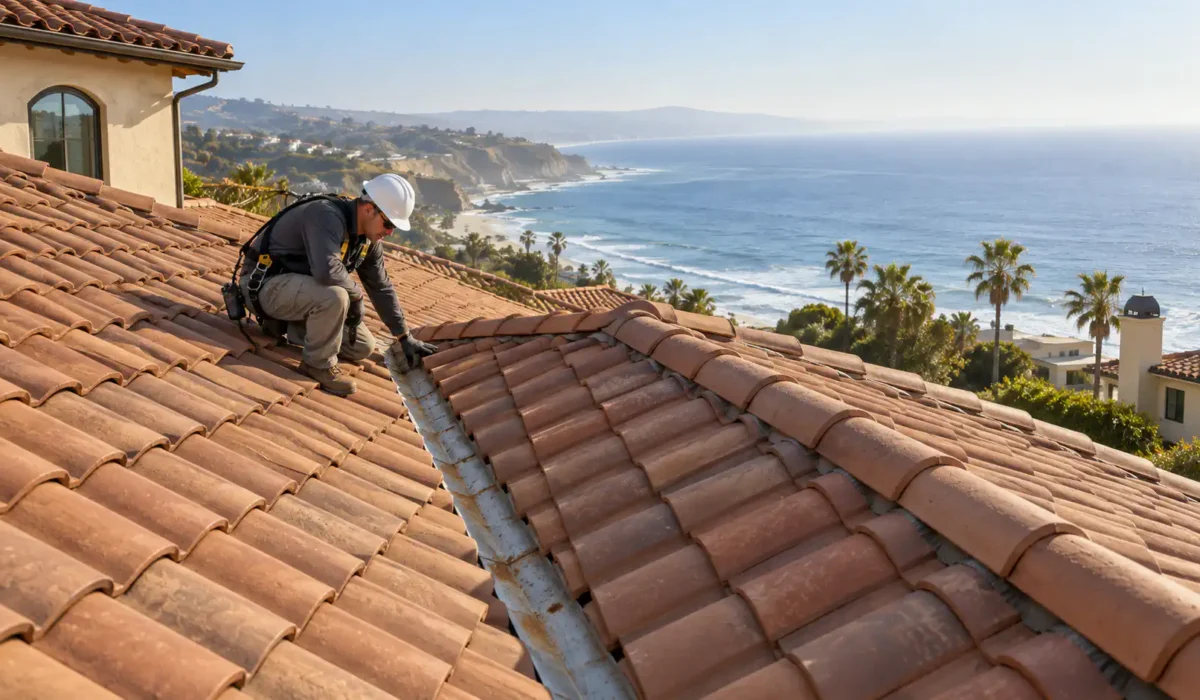
Coastal tile roofs can look nearly perfect from the street while corrosion is progressing in the metal components that hold the roofing system together. At Tile Roofing San Diego, located in San Diego, CA, we inspect clay and concrete tile roofs as complete water-management systems — not simply as rows of durable tiles. For properties in La Jolla, Del Mar, Coronado, Pacific Beach, Oceanside, Encinitas, and other communities exposed to marine air, fasteners, flashing, valley metal, eave components, vents, and roof penetrations deserve systematic corrosion checks.
Salt exposure matters because chloride-rich marine air can accelerate electrochemical corrosion when moisture and oxygen are present. The Federal Highway Administration notes that corrosion in coastal locations is accelerated by the combination of chlorides, moisture, and oxygen, while salt-laden Pacific air can travel inland depending on wind direction, distance from shore, and local topography.
For HOAs and property managers, the practical objective is simple: identify corrosion before a small metal component becomes a tile movement, drainage, flashing, or leak problem.
Why Coastal San Diego Tile Roofs Need a Corrosion Checklist
Clay and concrete roof tiles themselves do not rust. The vulnerable components are usually concealed beneath, beside, or between the tiles.
A typical tile roof may contain:
- tile nails, screws, clips, or wire attachments;
- valley flashing;
- drip edge and eave metal;
- pipe and vent flashings;
- chimney and wall flashing;
- counterflashing;
- skylight flashing;
- metal bird stops or eave closures;
- metal components around solar attachments;
- gutters, straps, and downspout connections.
A roof therefore does not have to show broken tiles to have a developing corrosion problem.
Coastal exposure also varies dramatically from property to property. A building directly exposed to onshore winds in Coronado may experience different conditions from a sheltered building farther inland, even if both are within the same general coastal zone.
Fastener Corrosion Checklist
Tile fasteners are especially important because much of their condition is hidden below the tile field.
We check accessible fasteners for:
- reddish-brown rust on steel nails or screws;
- thinning or flaking metal;
- deteriorated protective coatings;
- enlarged fastener holes;
- loose clips or attachments;
- fastener heads breaking away;
- rust staining running onto underlayment or battens;
- tiles that have begun sliding despite appearing unbroken.
A corroded fastener can gradually lose cross-sectional strength. Once attachment weakens, individual tiles may shift under gravity, maintenance traffic, vibration, or wind.
Material selection also matters. FEMA’s coastal corrosion protection guidance specifically states that unprotected steel corrodes rapidly in salt air and explains that galvanized steel can degrade more than 50 times slower than ungalvanized steel under the same coastal conditions. FEMA further identifies hot-dip galvanized and stainless-steel fasteners as important options for severe exposure.
FEMA guidance is particularly relevant to properties very close to the ocean: exposed roof connectors and fasteners within approximately 3,000 feet of the coastline may require enhanced corrosion resistance, with hot-dip galvanized steel or stainless steel specifically identified for salt-spray exposure.
For an HOA or apartment portfolio, fastener condition should therefore be evaluated by exposure level rather than assuming every building should receive an identical maintenance specification.
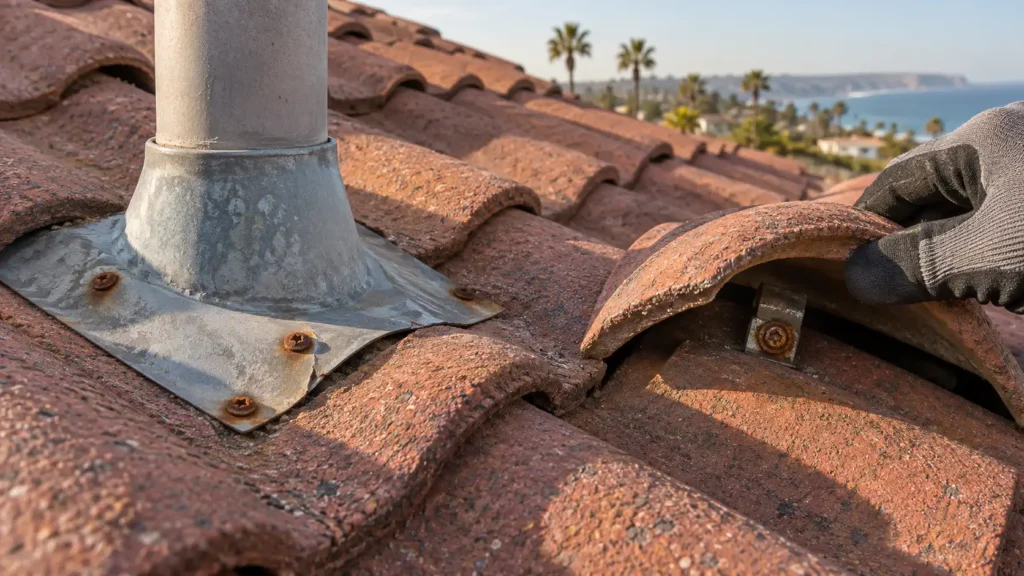
Flashing Corrosion Checklist
Flashing protects some of the most leak-sensitive areas of a tile roof. We pay particular attention to metal around:
- chimneys;
- skylights;
- plumbing vents;
- walls;
- roof-to-wall transitions;
- mechanical penetrations;
- solar mounting areas;
- changes in roof elevation.
We look for surface oxidation, rust perforation, separated seams, cracked protective coatings, pinholes, distorted metal, failing laps, and corrosion surrounding screws or nails.
Corrosion at a flashing does not need to create a large visible hole before it becomes significant. Thin metal can lose rigidity, seams may separate, and fastener locations can deteriorate enough to permit water movement.
We also check whether repairs have introduced incompatible metals.
Watch for Galvanic Corrosion Between Dissimilar Metals
Coastal salt and moisture can act as an electrolyte between different metals. When incompatible metals are placed in contact, one can corrode preferentially.
For example, problems can develop where repairs combine copper, aluminum, galvanized steel, stainless steel, or other metals without considering compatibility.
The Insurance Institute for Business & Home Safety recommends keeping flashing, cleats, fasteners, and adjoining metal components compatible because galvanic corrosion becomes more significant in coastal environments.
This issue is particularly important on older tile roofs that have accumulated repairs from multiple contractors over several decades.
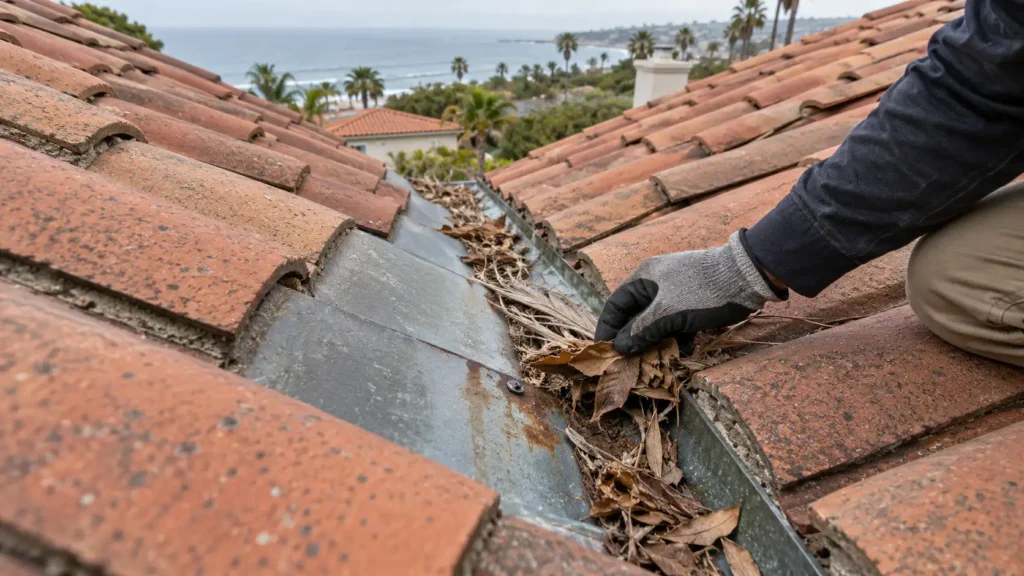
Valley Metal Corrosion Checklist
Valleys carry concentrated runoff from two intersecting roof planes, making them one of the highest-priority inspection areas.
We inspect valleys for:
- rust along the center channel;
- corrosion beneath accumulated leaves or sediment;
- deteriorated valley edges;
- exposed fasteners;
- punctures or previous repair holes;
- separation at metal laps;
- corrosion where different metals meet;
- debris trapping moisture against the valley;
- cracked or displaced cut tiles restricting drainage;
- water staining beneath the valley assembly.
Debris is particularly problematic because corrosion exposure is not determined only by distance from the ocean. A damp pile of leaves, palm debris, tile fragments, or organic material can create a localized microenvironment that remains wet longer than surrounding roof surfaces.
Federal corrosion research has demonstrated that salt accumulation in sheltered locations can produce significantly different corrosion behavior from surfaces periodically washed by rain. In one FHWA study, corrosion at an adverse bridge microclimate was approximately five times higher than at a standard coastal test location despite comparable chloride deposition.
The roofing implication is important: sheltered metal beneath tiles, debris, flashings, or roof accessories should not be assumed safe merely because exposed metal nearby looks clean.
Eave and Roof-Edge Corrosion Checklist
Eaves deserve special attention because several drainage and attachment components meet in a narrow area.
We examine:
- drip edge;
- gutter apron;
- bird stops;
- metal eave closures;
- lower-course fasteners;
- fascia connections;
- gutter brackets and screws;
- downspout connections;
- exposed sheet-metal edges.
Warning signs include orange or brown streaks, powdery corrosion deposits, blistering coatings, weakened screws, loose closures, sagging gutters, deteriorated fascia around fasteners, and separation between the roof edge and drainage components.
We also inspect beneath the first tile course where accessible. Corrosion can remain hidden behind an apparently normal eave while fasteners, closures, or metal edges deteriorate.
Coastal Tile Roof Corrosion Warning Signs
| Component | Early Warning Sign | Potential Consequence |
| Tile fasteners | Rusted heads or loose tiles | Tile displacement |
| Valley metal | Surface rust or trapped debris | Restricted drainage or leakage |
| Pipe flashing | Corrosion around collar or fasteners | Penetration leak |
| Wall flashing | Rust, separation, failed laps | Water behind tile assembly |
| Eave metal | Oxidation or loose connections | Roof-edge deterioration |
| Bird stop | Rusted attachment points | Loose closure or pest entry |
| Gutter hardware | Corroded screws or brackets | Sagging or failed drainage |
| Solar attachment area | Corrosion around metal interfaces | Water intrusion or attachment concerns |
Visible rust should be treated as evidence to investigate, not automatically as proof that complete roof replacement is necessary.
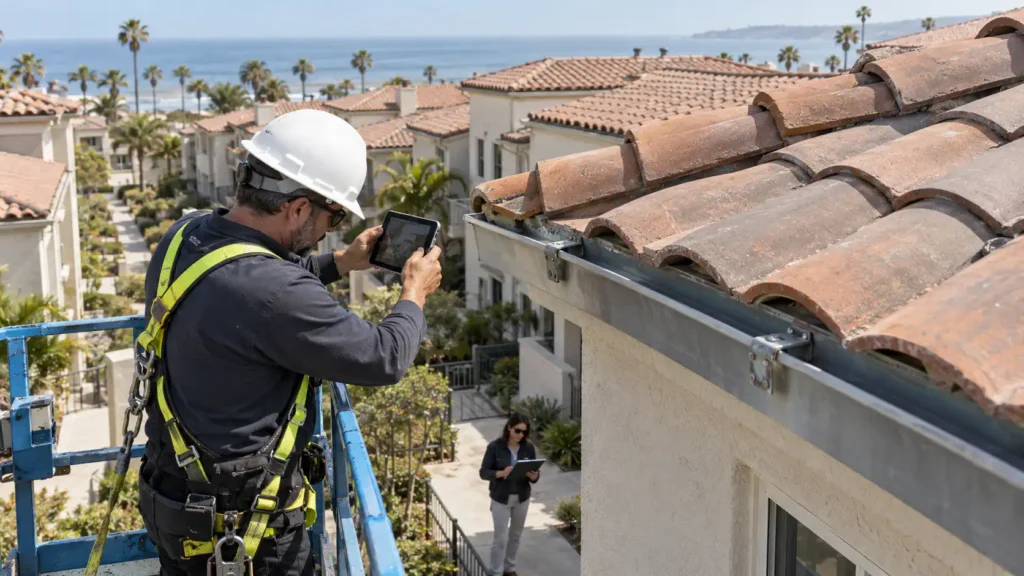
HOA and Property Manager Inspection Priorities
Large residential communities require a repeatable inspection process.
We recommend documenting the same roof zones during every scheduled assessment:
- Photograph representative fasteners and metal components.
- Record the exact building and roof elevation.
- Identify corrosion by component rather than writing only “roof rust.”
- Compare photographs with previous inspections.
- Separate cosmetic oxidation from section loss or perforation.
- Identify debris-retention areas.
- Record previous flashing repairs and metal types where known.
- Flag loose or displaced tiles associated with attachment deterioration.
- Inspect valleys and eaves before the rainy season.
- Prioritize buildings with direct ocean exposure or persistent marine-layer moisture.
For multifamily properties, consistent documentation allows managers to identify patterns. If similar fasteners or flashings are deteriorating across multiple buildings of the same age, the association can evaluate the problem systematically rather than funding isolated emergency repairs.
When Corrosion Requires Immediate Tile Roof Repair
Not every spot of oxidation requires emergency work. We prioritize repair when corrosion has begun affecting the function of the roof.
Higher-risk conditions include:
- perforated flashing;
- broken or missing fasteners;
- actively slipping tiles;
- weakened valley metal;
- corrosion accompanied by interior water staining;
- loose eave components;
- failed fasteners around roof penetrations;
- severe deterioration where dissimilar metals meet;
- corrosion beneath solar mounting or other rooftop equipment;
- metal that can be punctured or deformed with minimal pressure.
Once corrosion has reduced the integrity of a component, simply coating visible rust may not restore the original attachment or drainage function.

Do Not Inspect a Tile Roof by Walking Every Section
Clay and concrete tile can crack under concentrated foot traffic, especially older clay products and weathered tiles.
For that reason, we do not recommend turning a routine corrosion inspection into unnecessary roof traffic. Ground observations, ladders, pole cameras, drones, attic observations, and controlled access can often identify priority areas before individual tiles need to be lifted.
Where concealed fasteners or underlayment must be examined, selected tiles should be accessed carefully by personnel familiar with tile roofing.
Create a Coastal Roof Maintenance Record
For HOAs and property managers in La Jolla, Del Mar, Coronado, Pacific Beach, Encinitas, Oceanside, and similar coastal environments, corrosion management becomes more effective when every inspection contributes to a permanent roof history.
We recommend recording:
- roof age;
- tile type and profile;
- known flashing materials;
- fastener material where identifiable;
- previous corrosion repairs;
- valley condition;
- roof-edge condition;
- buildings with the greatest ocean exposure;
- photographs from repeat inspection points;
- dates of repairs and component replacement.
This record helps distinguish isolated defects from property-wide material aging.
CONCLUSION
A coastal tile roof corrosion inspection should extend far beyond looking for rust from the ground. We evaluate fasteners, flashings, valleys, penetrations, eave closures, gutters, metal compatibility, debris accumulation, and evidence of tile movement because these components work together as one drainage and attachment system.
For San Diego coastal properties, especially buildings exposed to marine air, the most valuable maintenance strategy is early detection. Tiles may remain serviceable for decades while comparatively small metal components deteriorate underneath them. A structured corrosion checklist allows homeowners, HOAs, and property managers to identify those weaknesses before they become displaced tiles, failed flashing, blocked drainage, or interior leaks.
FAQ
How often should a coastal tile roof be inspected for corrosion?
We generally recommend incorporating corrosion checks into routine roof inspections at least annually, with additional inspections after significant storms, reroofing work, solar installation, or other rooftop construction. Properties with strong direct marine exposure may justify more frequent observation of vulnerable metal components.
Does rust on tile roof flashing mean the entire roof needs replacement?
No. Localized corrosion may require only flashing, fastener, valley, or eave repair if the tiles, underlayment, and surrounding assembly remain serviceable. Extensive corrosion across multiple roof components can indicate a broader aging problem that requires a more comprehensive evaluation.
Which parts of a tile roof corrode fastest near the San Diego coast?
We pay closest attention to exposed or moisture-retaining metal components, including fasteners, valley flashing, pipe flashings, eave metal, bird stops, gutter hardware, solar attachment areas, and locations where incompatible metals touch. Actual deterioration depends on distance from the ocean, wind exposure, moisture retention, material selection, installation quality, and maintenance history.