
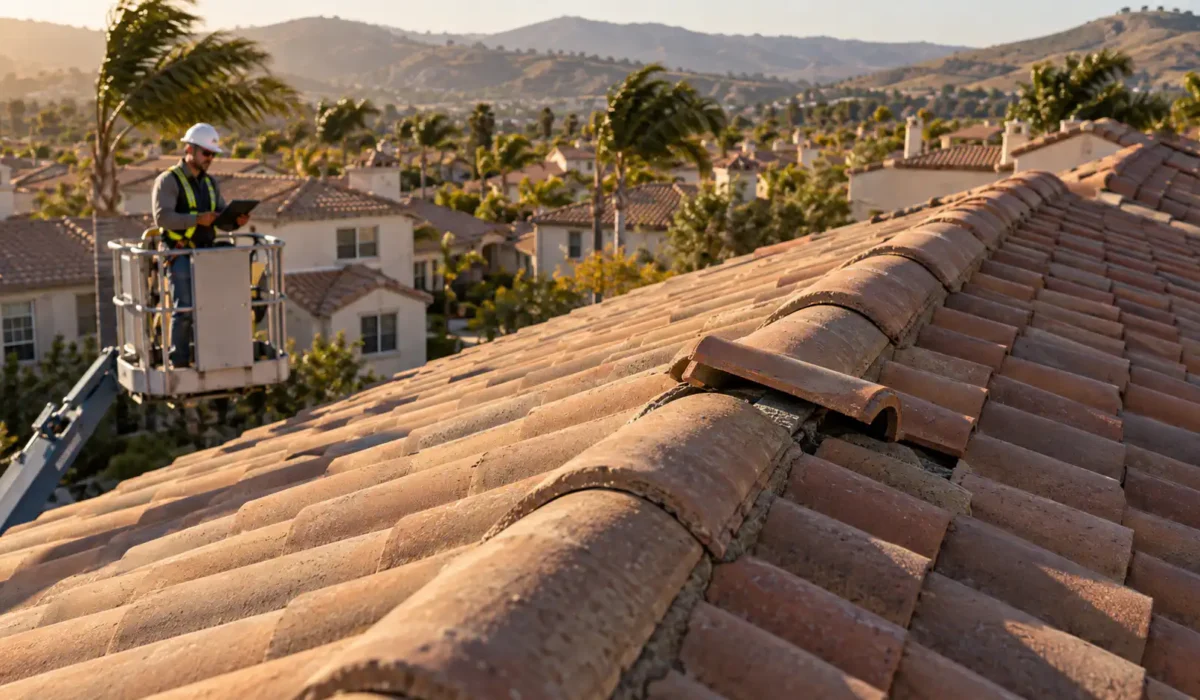
Santa Ana winds create a roofing problem that is especially relevant to San Diego’s tile-heavy residential communities. At Tile Roofing San Diego, we treat these events as a tile-system inspection issue rather than a generic storm-damage scenario because wind can shift, lift, loosen, or fracture individual tiles without producing an obvious leak on the day of the event. For HOA boards and property managers, the concern is whether wind changed alignment, attachment, ridge security, edge conditions, or water-shedding paths that may fail during the next rain.
Why Santa Ana Winds Matter to San Diego Tile Roofs
Santa Ana winds are strong, dry offshore winds that move from inland Southern California toward the coast. They can accelerate through mountain passes and foothill corridors before reaching valleys and developed communities. Wind exposure varies across San Diego County because terrain, roof height, building orientation, nearby structures, and canyon or slope exposure change the pressures applied to a tile roof.
Local history shows why a post-wind inspection can be justified even when damage appears scattered. According to the National Weather Service San Diego weather history, the May 12–15, 2014 Santa Ana event produced gusts of approximately 40–45 mph in parts of the coast and valleys and 60–80 mph in foothill areas. The NWS specifically reported that the winds “blew off some roof tiles.” Tile damage therefore does not require a hurricane-style event. Wind direction, repeated gusts, edge exposure, and the roof’s pre-existing condition all matter.
Wind-Driven Tile Slippage Is Often Subtle
A slipped tile does not always fall to the ground. It may move only enough to reduce the intended headlap or disturb the interlock with surrounding tiles. From the street, the roof can still look intact. At roof level, we may find a tile sitting lower than the adjacent course, a widened joint, an exposed nail hole, a lifted corner, or a displaced interlock.
Tile roofs are layered water-shedding assemblies: tile manages most rainfall, while underlayment and flashing provide secondary protection. If wind opens a path beneath the tile, the roof becomes more dependent on aging secondary materials. Small displacement is especially important at valleys, walls, penetrations, eaves, ridges, and roof-plane transitions.
Tile Roof Fasteners Can Be Stressed Without Visible Tile Loss
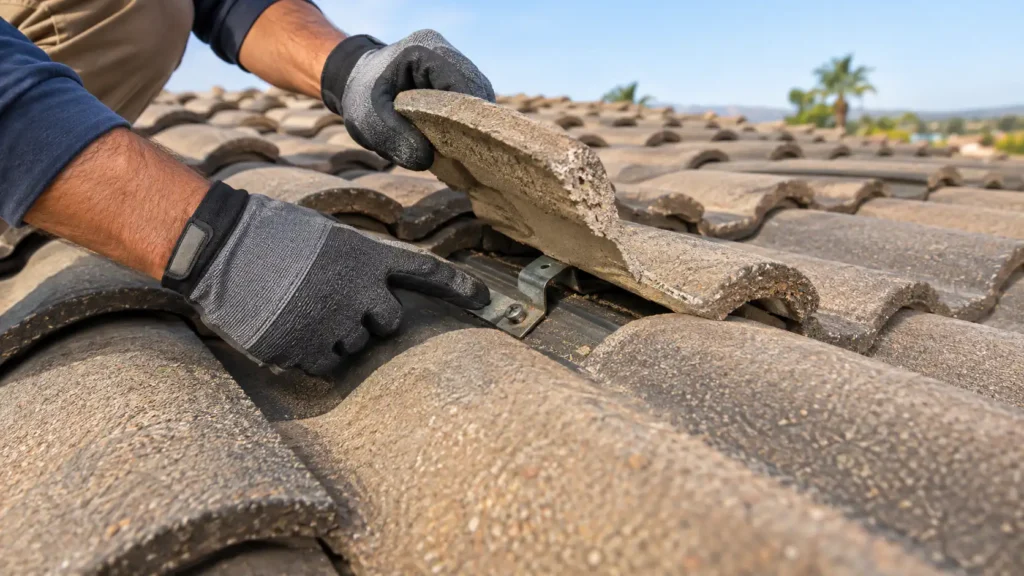
Concrete and clay tiles may be secured with nails, screws, clips, adhesives, mortar-set components, battens, or combinations of these methods depending on the roof design, installation era, manufacturer requirements, and code criteria. Wind does not have to remove a tile to affect attachment. Repeated uplift can enlarge a fastener hole, bend a clip, loosen a fastener, crack a tile around the attachment point, or allow a tile to rock during future gusts.
This is why we do not judge wind damage only by counting missing tiles. A roof may have zero tiles on the ground and still contain loosened field tiles or compromised perimeter tiles.
The current Tile Roofing Industry Alliance installation manual incorporates ASCE 7-16 and ASCE 7-22 wind-uplift design criteria and is intended to align with current IRC, IBC, and California Building Code requirements. Existing San Diego roofs may have been installed under older standards with different fastening patterns and perimeter details, so the original installation method matters when evaluating movement.
Ridge, Hip, Rake, and Perimeter Tiles Deserve Priority
Wind pressures are not distributed evenly over a roof. Perimeter and corner zones can experience greater localized suction than protected interior field areas, so a post-wind inspection should not treat every tile as equally exposed.
We begin with roof edges and changes in plane. Ridge and hip tiles can loosen where mortar, mechanical attachment, or underlying support has deteriorated. Rake or gable-edge tiles may be directly exposed to crosswinds. Eave tiles can be affected by uplift entering below the first course. Corner areas can show movement before the center of the roof field does.
On multi-building HOA properties, we compare similar elevations. If one building has slipped tiles on a wind-facing corner, comparable elevations on adjacent buildings deserve review.
Broken Tiles After Wind Are Not Always Freshly Broken
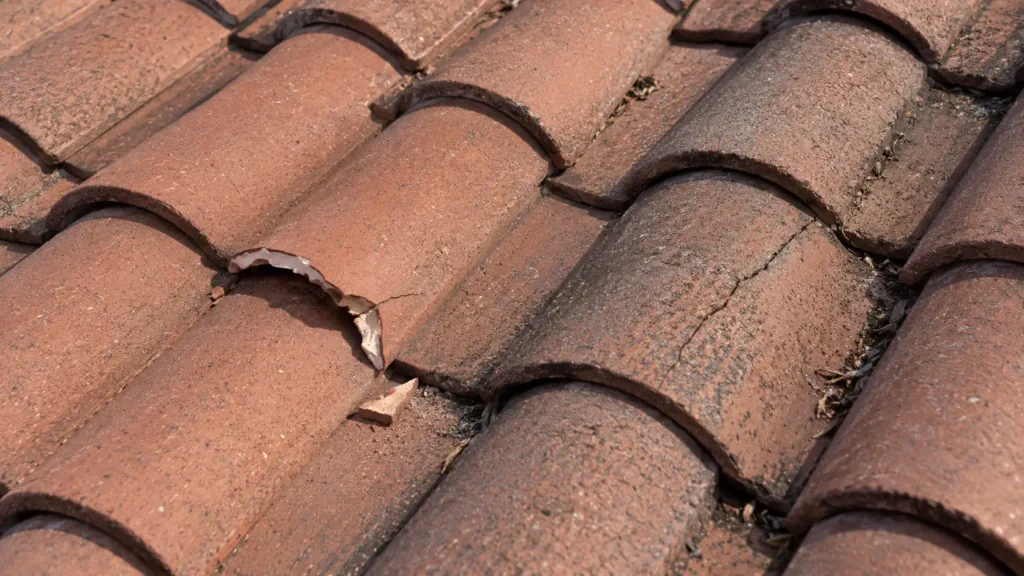
A critical inspection task is separating wind-related movement from older defects. Tile roofs can accumulate foot-traffic cracks, patched tiles, aged mortar, failed sealants, and previous repairs. Wind may expose or worsen those vulnerabilities without being the original cause.
We look for patterns rather than isolated damage. Fresh breaks, displaced fragments, newly exposed surfaces, tile-to-tile impact marks, concentrated movement on one elevation, or several shifted tiles in the same pressure zone can support a recent-event interpretation. Long-standing staining, old adhesive repairs, or settled debris beneath a broken tile may indicate an older condition.
For HOA documentation, a useful report should state what was observed, where it is located, how urgent it is, and whether the condition appears consistent with recent movement, deferred maintenance, prior repairs, or an uncertain cause.
What a Post-Wind Tile Roof Inspection Should Cover
A meaningful inspection should document the visible roof system, not only missing tiles. We evaluate tile alignment, cracked or broken units, attachment concerns, ridge and hip conditions, edge tiles, valley clearance, flashing transitions, penetrations, exposed underlayment, debris impact, and changes in water-shedding paths.
Where access allows, ceiling staining, attic moisture marks, or water entry near penetrations may show that wind movement affected the building envelope. The report should also identify areas that could not be safely verified. For a property manager, “not visible” is not the same as “no damage found.”

HOA Boards Need Building-Level Wind Inspection Records
For an HOA, one Santa Ana event can affect many roofs built at the same time with similar materials. We recommend documenting each building by address or building number, roof elevation, observed condition, photo location, and repair priority.
A practical classification can separate immediate hazards, near-term repairs, monitor conditions, and no visible wind-related defects. This prevents overgeneralizing one resident complaint across an entire community.
Property managers should preserve dated roof photographs so later wind events can be compared against a reliable baseline.
What Requires Immediate Attention After a Wind Event
Priority conditions include tiles hanging over an edge, loose ridge or hip pieces, broken tiles above walkways, exposed underlayment, open flashing transitions, multiple displaced tiles in one area, and any wind-created opening before rain.
A loose concrete or clay tile is not only a leak risk; it can become falling debris. In multifamily communities, we give extra priority to roof sections above entrances, sidewalks, patios, parking areas, and other high-traffic locations.
Temporary stabilization may be appropriate when matching tile is unavailable, but it should protect the assembly without blocking drainage or disguising a condition that still requires permanent correction.
Repair Decisions Should Match the Failure Pattern
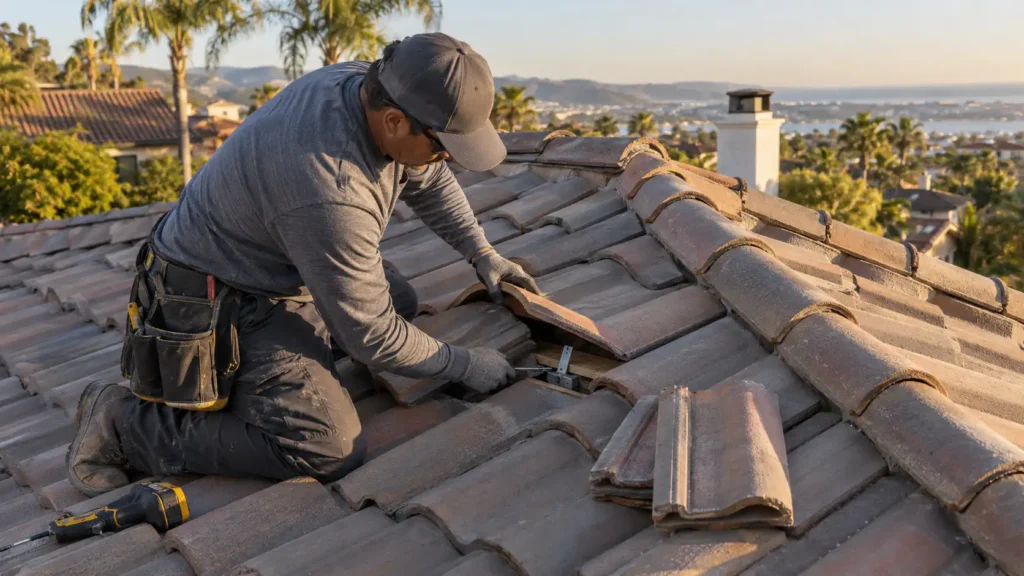
Post-wind repairs should address why a tile moved, not simply place it back into position. If one tile slipped because its fastener failed, resetting the tile without correcting attachment leaves the same vulnerability. If several tiles moved because an edge detail has deteriorated, replacing only the visibly broken units may miss the underlying pattern.
We separate isolated tile replacement from attachment repair, ridge or hip repair, flashing correction, and broader lift-and-relay considerations. On older roofs, wind damage may reveal that the tile remains serviceable while the underlayment or fastening system has entered a higher-maintenance phase.
For San Diego associations, that distinction supports reserve planning by identifying immediate repairs and roof sections where repeated spot repairs may no longer be efficient.
CONCLUSION
Santa Ana winds create a distinctly Southern California tile-roof risk: localized uplift, tile slippage, attachment stress, and ridge or edge movement that may not be obvious from the ground. We recommend that San Diego HOA boards and property managers evaluate roofs after significant wind events based on actual tile movement and system condition, not on whether the event carries a dramatic storm label. A documented inspection by Tile Roofing San Diego can help separate urgent safety issues from routine repairs, establish a condition baseline, and reduce the chance that a small displacement becomes a leak during the next rain.
FAQ
Can Santa Ana winds damage a tile roof without blowing tiles off?
Yes. Wind can lift, shift, loosen, or crack tiles while leaving them on the roof. Even minor movement can reduce overlap, expose attachment points, or change drainage paths, especially near ridges, hips, rakes, eaves, valleys, and penetrations.
When should an HOA schedule a tile roof inspection after Santa Ana winds?
An inspection is appropriate after a significant local wind event when there are resident reports, visible tile movement, debris around buildings, known older roof sections, or roofs exposed to canyons, slopes, open terrain, and wind-facing elevations.
What should a post-wind tile roof inspection report include?
A useful report should identify the building and roof area, photograph observed conditions, note slipped or broken tiles, evaluate ridge and perimeter areas, identify exposed underlayment or flashing concerns, classify urgency, and distinguish likely recent movement from older maintenance issues whenever possible.