

A tile roof can leak even when every visible clay or concrete tile appears intact. At Tile Roofing San Diego in San Diego, CA, we treat the tile surface as only one part of the roof’s water-management system. Tiles shed most rainfall, while underlayment, flashings, valleys, fasteners, and roof-to-wall transitions manage water that reaches beneath them. When those hidden components age, tear, separate, corrode, or are installed incorrectly, water can reach the roof deck without an obvious broken tile above the leak.
Why an Intact Tile Roof Can Still Leak
Clay and concrete tiles overlap to direct water downslope; they do not form one continuous membrane. Wind-driven rain can enter through side laps, head laps, profile channels, penetrations, or transitions. A properly built system anticipates this with a secondary drainage plane beneath the tile.
Underlayment should collect incidental moisture and route it toward the eaves or suitable flashing. Flashing performs the same function at interruptions such as chimneys, vents, skylights, walls, valleys, plumbing penetrations, solar mounts, and changes in roof plane.
This layered approach is reflected in the Tile Roofing Industry Alliance’s technical guidance. For penetrations, TRIA explains that “all penetrations or disruptions to the field tiles” should receive appropriate deck/underlayment flashing as well as tile flashing. When one of those drainage layers is missing, damaged, or reverse-lapped, the visible tile can look perfect while the assembly below it leaks.
How Tile Roof Underlayment Fails
Underlayment is hidden, so deterioration can advance for years before anyone sees it. Older tile roofs may contain asphalt-saturated felt that becomes brittle from age, heat cycling, moisture exposure, and movement around fasteners.
Common failures include:
- Brittle or cracked felt: Aging material can split when tiles shift or are lifted during other work.
- Punctures around fasteners: Nails, screws, clips, and later penetrations can create openings that enlarge as material deteriorates.
- Failed laps: Water can move beneath a course when seams are damaged, poorly overlapped, or reverse-lapped.
- Open transitions: Underlayment may be cut incorrectly around walls, skylights, vents, valleys, or chimneys.
- Old patches: Mastics and small patches may slow a leak without restoring a continuous drainage plane.
- Previous exposure: A displaced tile may expose and weaken underlayment even after the tile is repositioned.
These leaks may appear only during prolonged or wind-driven rain, while the same roof remains dry during a light shower.
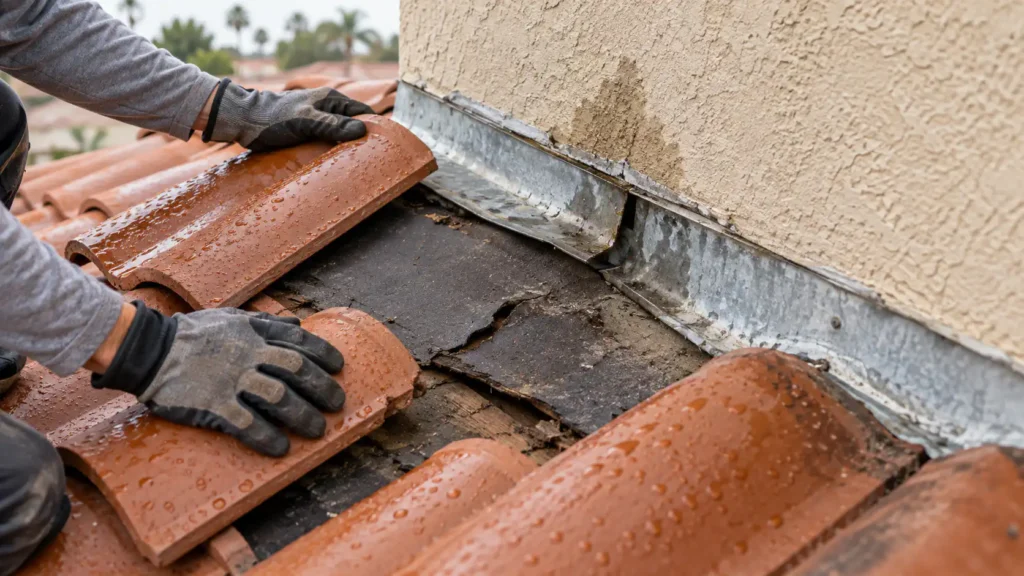
Flashing Failures That Cause Hidden Tile Roof Leaks
Flashing is frequently the source when surrounding tiles are intact. Metal and membrane flashings must be layered so water drains over the next lower component. If water is directed behind an upper layer, sealant alone is rarely a durable correction.
Roof-to-Wall and Stucco Transitions
San Diego homes commonly combine tile roofs with stucco walls, second-story walls, and chimneys. These intersections require integrated flashing and counterflashing. Problems develop when flashing is too short, buried incorrectly behind stucco, separated from underlayment, or repeatedly patched with caulk.
Water can enter high on a transition and emerge several feet away, so a ceiling stain is not a reliable map of the roof entry point.
Valleys
Valleys receive concentrated runoff from two roof planes. Leaves, palm debris, sediment, mortar fragments, and tile pieces can restrict drainage, allowing water to rise above the intended channel and reach underlayment at tile edges.
Leaks can also develop from corroded metal, punctured underlayment, incorrect laps, or repair materials that create dams. A valley that looks acceptable from the ground can still have hidden defects beneath adjacent tiles.

Pipes, Vents, Skylights, and Solar Penetrations
Every penetration interrupts the drainage plane. Proper detailing must manage water at both the tile surface and deck/underlayment level. A plumbing vent with an intact visible boot can still leak if deck flashing below it was omitted or poorly integrated.
The same applies to skylights and solar attachments. Surface sealant can conceal a defect instead of correcting it; when the sealant cracks or separates, water follows the underlying installation error.
Why San Diego’s Climate Can Hide Roof Leaks
San Diego’s long dry periods can make a marginal roof appear sound. According to the NOAA 1991–2020 climate normals for San Diego Lindbergh Field, normal annual precipitation totals approximately 9.79 inches. January, February, March, and December alone account for about 7.31 inches of that total, showing how strongly rainfall is concentrated in the cooler portion of the year.
A flashing defect or weakened section of underlayment can therefore remain dormant through extended dry weather and become obvious only when winter storms create sustained runoff.
Dry weather also complicates diagnosis. By the time a property manager sees a ceiling stain, the roof may already be dry, and the visible mark may be far from the entry point. We therefore rely on roof-system logic, moisture evidence, and controlled inspection rather than assuming the tile directly above the stain is defective.
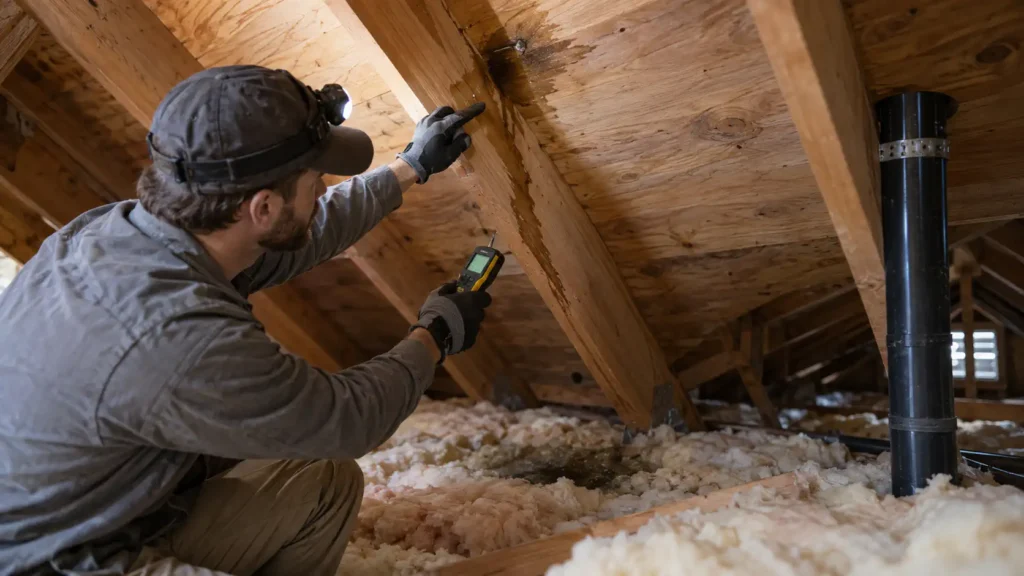
How Water Travels Before It Appears Indoors
After passing the underlayment, water may travel along sheathing, framing, nails, pipes, insulation, or ceiling components. It can also move laterally between layers before gravity sends it to a visible interior surface.
This explains why a stain may appear beneath intact tile, why water can show up beside a wall even when entry began near a chimney, or why a leak appears during only one wind direction. It also explains why replacing the tile directly above a stain may not solve the problem.
For reliable tile roof leak detection, we trace the drainage path from the roof geometry inward rather than starting and ending at the ceiling stain.
What a Professional Tile Roof Leak Inspection Should Check
A useful inspection evaluates the roof as an assembly. We examine the likely drainage path, valleys, roof-to-wall intersections, flashings, penetrations, skylights, chimney details, previous repairs, exposed fasteners, debris, and accessible underlayment condition.
Where appropriate, selected tiles may need to be carefully lifted to see whether underlayment is brittle, torn, patched, punctured, or disconnected from flashing. Simply walking the roof and counting cracked tiles does not provide enough information to diagnose many hidden leaks.
Attic access can provide additional evidence, including staining on sheathing, dark marks around fasteners, damp insulation, water tracks on framing, or previous wood repairs. The direction and pattern of those marks can help distinguish an isolated flashing defect from broader underlayment deterioration.
Inspection is especially important when a roof has already received several leak repairs. Layers of sealant, replaced tiles, patched felt, and modified flashing can change the original drainage path and make the next leak more difficult to trace.
Tile Roof Leak Diagnosis for HOAs and Property Managers
For an HOA or multi-unit property, leak diagnosis should be documented consistently. One roof plane may serve several units, and repeated isolated repairs can hide a larger system-wide problem.
We recommend recording the unit, interior stain location, date of leakage, storm direction when known, previous repair area, roof elevation, and photographs. Mapping multiple reports can reveal patterns around a shared valley, wall transition, drainage path, or aging underlayment zone.
For example, three separate ceiling leaks reported by three owners do not necessarily represent three unrelated roof defects. If those units are located beneath the same long valley or roof-to-wall transition, they may be different symptoms of one drainage failure.
Property managers should also distinguish between symptom repair and system repair. Replacing one tile or applying sealant may address a visible condition, but it does not restore failed underlayment beneath a larger field. Repeatedly paying for small repairs without documenting the condition below the tile can make long-term budgeting more difficult for an HOA.

Repair, Lift and Relay, or Full Replacement?
The correct scope depends on what has failed. A localized repair may be appropriate when underlayment damage is confined and the surrounding system remains serviceable. Flashing repair may require removing enough tile to rebuild the transition correctly rather than coating the surface with sealant.
When underlayment deterioration is widespread but clay or concrete tiles remain reusable, we may lift and stage the tiles, remove old underlayment, inspect and repair damaged decking, install new underlayment and flashings, and relay the serviceable tile. This approach addresses the hidden water-management system without automatically discarding valuable tile that may still be functional.
Full replacement is more appropriate when tile is extensively damaged, compatible materials are unavailable, the roof is being substantially altered, or several major system components have reached the end of useful service together.
The important decision is not whether the tiles look old. It is whether the complete roof assembly can still move water from the top of the structure to the eaves without allowing moisture to reach the deck.
Conclusion
A tile roof leak without broken tiles is not unusual. The visible tile is the outer water-shedding layer; the hidden underlayment and flashing network determines whether moisture beneath it drains safely or reaches the structure. For San Diego homeowners, HOA boards, and property managers, the most effective response is a system-level inspection that traces water pathways, evaluates hidden underlayment, examines valleys and penetrations, and verifies flashing at transitions before selecting a repair scope.
Frequently Asked Questions
Can a tile roof leak if none of the tiles are cracked?
Yes. Intact clay or concrete tiles can still allow incidental or wind-driven moisture beneath the roof covering through normal overlaps and transitions. If underlayment is deteriorated or flashing is improperly integrated, water can reach the roof deck even when visible tiles look undamaged.
How can we tell whether a leak is from underlayment or flashing?
Leak location, roof geometry, storm conditions, attic evidence, previous repair history, and inspection beneath selected tiles help identify the source. Leaks concentrated around walls, valleys, chimneys, vents, skylights, or other penetrations often point toward flashing problems, while multiple leaks across different sections of an older tile roof can indicate broader underlayment deterioration.
Does a leaking tile roof always need complete replacement?
No. A localized flashing or underlayment defect may be repairable. If the existing tiles remain serviceable but the underlayment has failed across a large area, a lift-and-relay project can preserve reusable tile while renewing the underlayment, flashing, and other critical water-management components beneath it.