
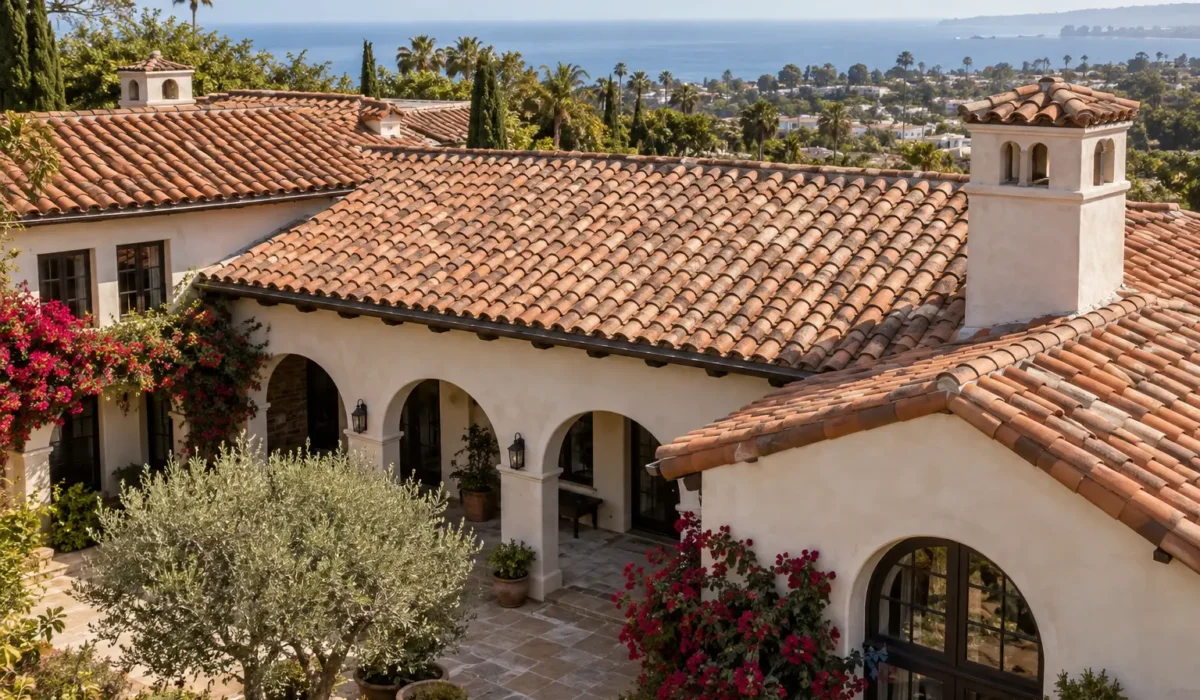
For Spanish Colonial, Mediterranean, Mission Revival, and coastal estate architecture, the roof is a defining visual element. At Tile Roofing San Diego, we approach clay barrel tile restoration in San Diego as both a roofing and architectural preservation project. For premium homes, HOA communities, and managed properties in La Jolla, Coronado, Rancho Santa Fe, and Del Mar, the goal is to preserve the color variation, shadow lines, and aged character of original clay tile while rebuilding the concealed roofing system beneath it.
Why Clay Barrel Tile Restoration Is Different From Standard Reroofing
Traditional barrel, Mission, and two-piece clay tile roofs create a three-dimensional pattern that is difficult to reproduce once original material is lost. Older roofs may contain varied terracotta shades, firing marks, patina, and dimensions that no current production line matches exactly. Replacing weathered original tile with uniformly new material can change a home’s curb appeal even when the new product is technically acceptable.
Restoration therefore begins with a different question: how much of the original roof can be responsibly preserved? We evaluate tile separately from underlayment, flashing, fasteners, battens, valleys, and deck. A roof may leak because concealed waterproofing has aged even though much of the clay tile remains sound. In that situation, a controlled lift-and-relay restoration can preserve valuable material while renewing the components that manage water.
The Tile Roofing Industry Alliance reports average moisture absorption of less than 1% for clay and concrete tile and emphasizes the material’s durability. That performance is one reason an older tile field should be assessed before complete replacement is specified.
Preserving Spanish and Mediterranean Character in San Diego
Clay barrel roofs are inseparable from much of San Diego’s Spanish-influenced architecture. Rounded profiles create deep shadow lines; warm reds, oranges, browns, and weather-softened blends complement stucco walls, arched openings, courtyards, exposed wood, and low-slope roof forms. A successful restoration must preserve those relationships rather than treating the roof as an isolated component.
This is especially important for distinctive homes and estates in La Jolla, Coronado, Rancho Santa Fe, and Del Mar, where material consistency affects the entire elevation. HOA boards and architectural committees may also require visual continuity.
The City of San Diego notes that historic-preservation efforts can “stabilize neighborhoods” and “promote cultural heritage tourism.” Even when a property is not formally historic, the preservation principle remains relevant: original materials and proportions often contribute materially to perceived quality.
The Restoration Assessment: Tile, Underlayment, Flashing, and Deck
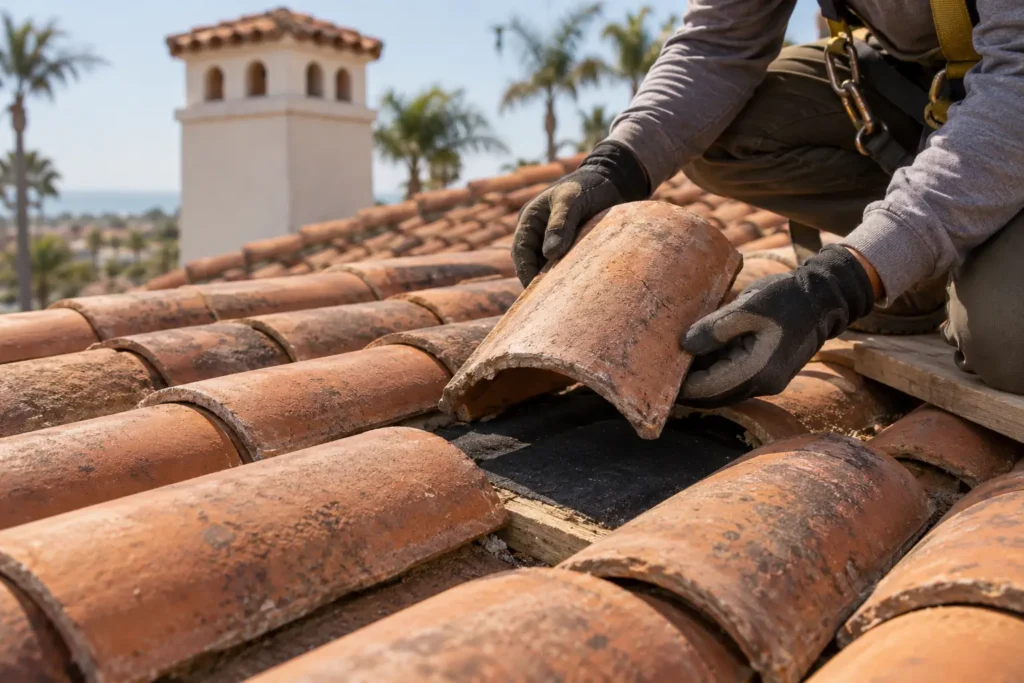
A detailed clay tile roof assessment should map the roof by slope, elevation, tile profile, color blend, and condition. We look for broken pans and caps, cracked corners, displaced pieces, old adhesive repairs, mismatched tiles, deteriorated mortar, blocked drainage channels, failed flashing, soft decking, and leaks around penetrations.
The underlayment deserves separate attention. Clay tile sheds most rainfall, but wind-driven water or moisture entering through normal overlaps can reach the layers below. Aging felt can become brittle, tear around fasteners, separate at laps, or fail where earlier repairs were cut into the system. Valleys, skylights, chimneys, walls, pipe penetrations, and low-slope transitions deserve particular scrutiny because they concentrate drainage or require precise flashing integration.
We also document tile quantity and availability before work begins. If the profile is discontinued, the plan should identify salvageable tiles, matching inventory, and locations where replacement material can be least visible.
Original Clay Tile Reuse and the Lift-and-Relay Process
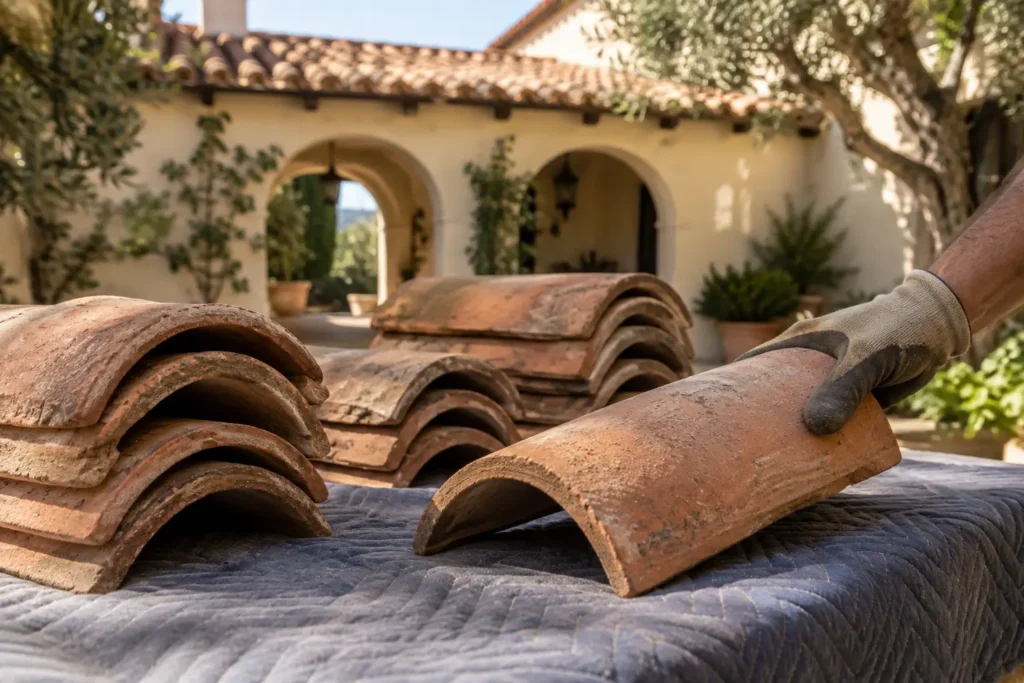
When tile remains serviceable but the underlayment has deteriorated, lift and relay can be the most architecturally sensitive solution. Tiles are removed in sequence, inspected, sorted, and staged so reusable pieces can return to the roof without unnecessary handling damage.
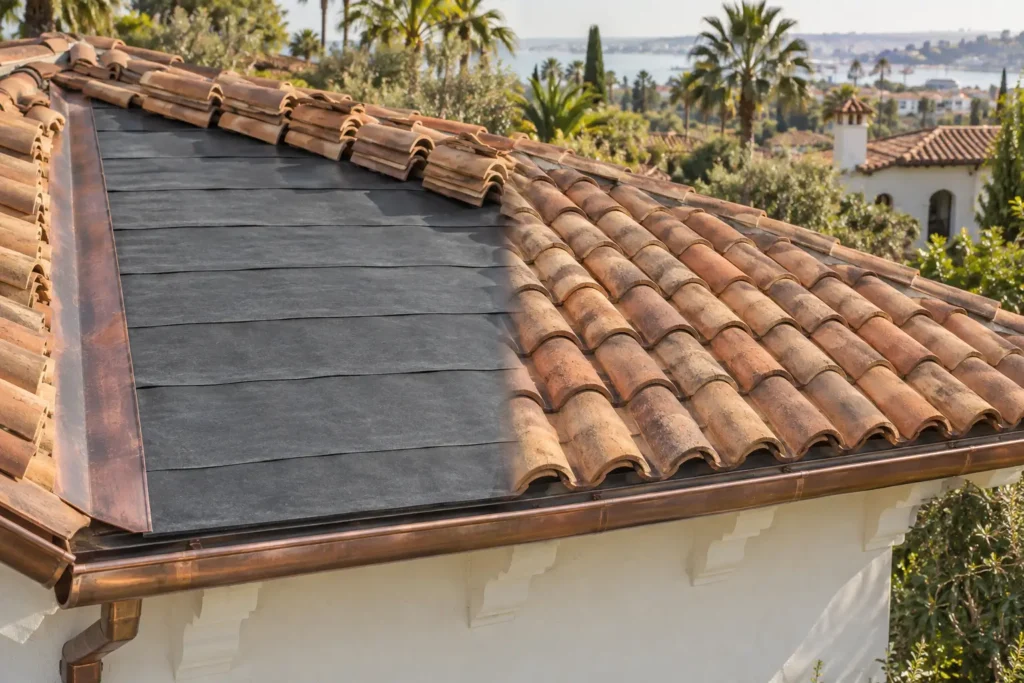
Once the tile is removed, old underlayment and worn accessories are stripped so the deck can be inspected. Damaged sheathing is repaired where necessary, then the roof is rebuilt with compatible underlayment, integrated valley metal, eave protection, wall and penetration flashing, and fastening details appropriate to the assembly. Original tiles are relaid while maintaining coursing, exposure, headlap, and profile alignment.
For two-piece Mission systems, positioning of pan and cover tiles is critical to drainage and the barrel appearance. For one-piece S or barrel profiles, replacement pieces must match color, dimensions, interlock geometry, thickness, and installed exposure.
Underlayment Replacement Is the Hidden Core of Restoration
Premium clay tile restoration should not focus only on what is visible from the street. Once the tile field is lifted, underlayment becomes the foundation of the renewed system. Product choice should reflect roof slope, manufacturer requirements, local code, service conditions, valleys, and penetrations.
The objective is continuous drainage. Upper layers must lap over lower layers so water is directed toward the eaves rather than behind flashing. Penetrations should be integrated into the drainage plane, not merely surrounded by surface sealant. Valleys require clear runoff paths, and transitions must prevent water from backing beneath tile.
This is also the stage to correct hidden legacy problems such as reverse laps, abandoned fastener holes, undersized flashing, deteriorated wood nailers, poorly terminated underlayment, or patchwork repairs around solar, HVAC, skylights, and plumbing vents.
Color Blending, Salvage Strategy, and Curb Appeal
A clay roof can be watertight and still look wrong. Premium restoration requires visual planning. We separate reusable tiles by tone, weathering, and surface character, then redistribute them so the finished roof preserves a natural blend. Concentrating new replacement tiles in one prominent field can create an obvious patch.
Matching salvaged tile can be reserved for front elevations, entry courts, prominent hips, or street-facing slopes. New matching material can be placed in less visible areas when appropriate. Ridge, hip, and rake details also matter because their proportions influence the finished silhouette.
The goal is not to make a mature clay roof look artificially new; it is to make it look intentional, balanced, clean, and structurally renewed without erasing its original character.

HOA and Property Manager Planning for Clay Tile Restoration
HOA boards and property managers need a scope that can be reviewed, budgeted, documented, and communicated to owners. Before work begins, we recommend documenting the tile profile, color range, replacement criteria, samples, staging, access limitations, landscape protection, and treatment of architectural details.
On multi-building communities, consistency is critical. A master inventory of tile profiles, approved sources, photographs, and color-blending standards helps prevent future repairs from creating obvious differences between buildings.
For occupied luxury properties, logistics also affect quality. Tile staging, debris movement, driveway protection, pedestrian access, pool and landscape protection, and daily cleanup should be planned before the first tile is lifted.
When Full Tile Replacement Makes More Sense
Complete replacement may be more practical when breakage is widespread, existing tile is badly spalled or structurally weak, compatible material cannot be sourced, roof geometry has changed, or previous repairs have left the field too inconsistent to reinstall reliably.
The decision should be based on measurable condition, not age alone. A roof with reusable clay and failed underlayment is different from a roof whose tile is no longer dependable. Separating those conditions prevents owners from discarding serviceable architectural material or investing heavily in a tile field that cannot support a durable restoration.
Conclusion
Clay barrel tile restoration in San Diego is most successful when preservation and roofing performance are treated as one scope of work. By evaluating original tile, replacing deteriorated underlayment and flashing, repairing the deck, controlling replacement-tile selection, and relaying the roof with disciplined color and profile matching, we can retain the Spanish or Mediterranean character that gives a premium property its identity. For homeowners, HOAs, and property managers in La Jolla, Coronado, Rancho Santa Fe, Del Mar, and throughout San Diego, a well-planned restoration protects both the building envelope and the curb appeal that makes the property distinctive.
Frequently Asked Questions
Can original clay barrel tiles be reused during a San Diego roof restoration?
Yes, when individual tiles remain structurally sound and can be removed without excessive breakage. We inspect and sort the existing material, discard damaged pieces, protect reusable tiles during staging, and reinstall them over renewed underlayment and flashing. Feasibility depends on tile condition, fastening method, roof access, and matching replacement availability.
Does an HOA need to approve clay tile roof restoration?
Many HOAs require architectural review when roofing materials, visible colors, profiles, or exterior appearance may change. The exact requirement depends on the community’s governing documents. A restoration plan is easier to review when it includes existing-roof photographs, the tile-reuse strategy, replacement-tile samples, color-blending expectations, and whether the visible roof appearance will change.
Is underlayment replacement enough if the original clay tile still looks good?
It can be, but only after the entire roof system is evaluated. Serviceable tile may justify a lift-and-relay approach, while the exposed deck, valleys, flashings, battens, fasteners, vents, and penetrations are repaired or replaced as needed. Reusing attractive tile over unresolved deck or flashing defects would preserve appearance without solving the underlying water-management problem.